
The grid operators for the North East, the Midlands, Southwest and Wales are aiming to partner with community energy groups ahead of changes to regulated costs paid in consumer energy bills.
Grid operators Northern Powergrid and Western Power Distribution, tasked by Ofgem with an overhaul in the way they operate, have asked for help from community groups, with 21 and 97 community energy groups respectively in their service areas.
Both Distribution Services Operators (DSO), also known as Distribution Network Operators (DNOs), had input from community energy non-profit Regen in developing their plans for contracting community energy groups to assist them in the roll-out of changes across their service areas.
Northern Powergrid has also started a newsletter targeting community energy groups in the North East.
Ofgem is targeting zero-carbon energy in the UK, partly by convincing consumers to digitally participate in renewable energy and demand reduction markets, with utilities and energy consumers communicating, for example, about when to charge electric cars or run appliances. It aims to prevent a grid overhaul to deal with grid issues that could cost consumers more, it said.
Consumers who see their energy costs rise with the changes may possibly experience a kind of energy poverty that requires working with DSOs and digital applications to resolve. Community energy groups are being asked to help with such issues.
Need for North East energy poverty, demand reduction and energy generation partners
On 14 May, Northern Powergrid published its Community Energy Engagement Strategy (2020 to 2023) explaining how it plans to work with regional community energy groups, based on advice from trade body Community Energy England and Regen and interviews with 17 local community energy representatives.
The operator acknowledged that “the end of the Feed-in Tariff means there is a lack of viable business models for community energy”.
Providing a new revenue stream, the operator plans to help community energy groups learn about services they could perform for pay and would suit Ofgem's new pricing agenda.
With respect to new projects, it plans to support community energy via the phone on “new ideas that haven’t been done before". It also appointed a sustainability manager, Anda Baumerte, whose email is published and will be a dedicated contact for community-energy-related questions.
In response to community group requests for finance the operator pledged to consider paying a referral fee to community and local energy organisations who make referrals to its “Poverty Services Register” supporting those with energy poverty. It plans to review the idea at a senior level, and if agreed, set aside a budget and implement a process for referral fee payments.
It wants to facilitate adding not just new renewable energy, but a range of other projects and will recruit existing groups such as community land trusts, parish and town councils, climate action groups and others to deliver them.
The operator called for “community-led renewable energy, energy demand reduction, and energy supply projects that have a significant proportion of local ownership and/or control.”
It also pledged to explore the theme of “energy efficiency and demand reduction” with communities at its planned community energy events during 2020, such as Community Energy Fortnights.
One of the proposed projects concerns electric vehicle integration.
Patrick Erwin, policy and markets director for the grid operator said in the strategy document, “Our customer-led distribution system programme is exploring the potential for our network to operate a more flexible energy system and our smart Grid Enablers programme is preparing our network for the rapid growth of electric vehicles.”
The DSO will also offer a visual map of its grid in a desktop app useful for electric vehicle projects at the design stage, it said.
With respect to deciding which of the community groups or companies vying to be awarded agreements will become service partners, it said it would “consider integrating a social and environmental weighting when procuring flexibility services”.
Already the grid operator has tested the waters with local community energy pilots such as Energise Barnsley’s residential solar, battery and virtual power plant, energy switching service HartlePower and demand reduction app project ACE.
With the strategy, it has also pledged to become an advocate for community energy to government bodies BEIS and Ofgem in future consultations on new policies, by responding in collaboration with Community Energy England. It also said it had conveyed the most recent interviews back to the government.
Western Power Distribution seeks to "co-create" on energy efficiency, fuel poverty and generation
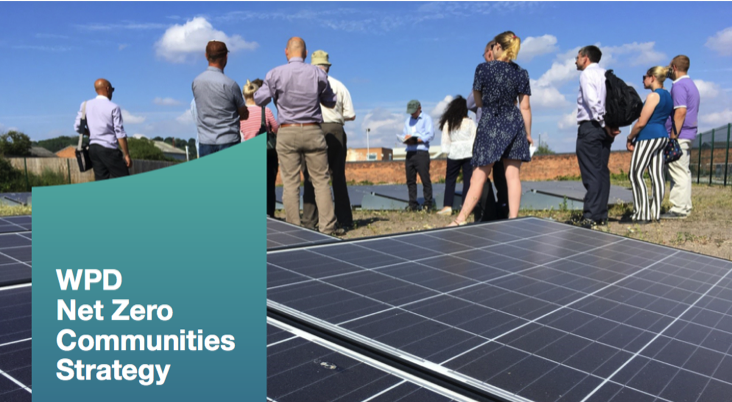
With the publication of its own strategy, WPD Net Zero Communities Strategy which was also developed in partnership with Regen, Western Power Distribution plans on working with community and local energy organisations in Midlands, Southwest and Wales.
In the strategy, WPD explains how it will be working with communities on more smart energy projects, and helping local groups access data to develop their own smart local energy systems. There will also be a series of events and even festivals on the theme, aiming to drum up support and participation.
Like the other DSO, WPD will aim to help community groups learn about options for the types of services they will be able to provide by partnering on “innovation projects”. And like the other DSO, WPD is feeding back its community energy data to BEIS.
WPD plans to not only co-create its business plan for the five-year RIO-II period with community energy groups, it plans to allocate funds for certain community energy projects.
It said it planned to by March 2021, “allocate ....funding for community groups that are taking action to reduce the carbon impact of their communities through energy generation and efficency projects, and projects that address fuel poverty."
Another key development to take place by September is that the DSO plans to collect substation data from eight communities through its Open LVproject, “to enable a smarter, more flexible energy system and new low carbon projects”. It solicited interested communities to complete an expression of interest form on the Centre for Sustainable Energy’s website.
The DSO pledged to use technology and open data to inform community groups looking to provide flexibility services.
Already, it has published the data showing where the services are needed on its website and sets “no minimum entry threshold so that smaller-scale players are not excluded”.
WPD is also looking to publish an online public-facing data hub, part of its Presumed Open Data project showing all of its energy-related project needs for prospecting by community groups.
By March 2021, WPD will start hosting bookable “surgeries” on local connections for community energy groups. By the end of the year it will have community energy grid connection requests dealt with proactively, and it will distribute to such groups a survey of the options being considered for “increasing network access." It will also begin producing a report on all the community energy connected to its network, but it didn’t say whether or not this would be a public report.
Fuel poverty strategy
Fuel poverty is one key focus in the strategy. WPD’s social indicator map developed with Centre for Sustainable Energy, pinpoints what areas have the most vulnerable customers to “help organisations such as community energy groups” assist them. It pledged to protect customers, saying it had built a ”core consumer vulnerability strategy by adding a new pillar, “leave no vulnerable customer behind in a smart future.”
WPD has a history of working on energy pilots with community groups. In 2018 it launched an app which allows customers to see the generation mix of electricity at their postcode, and it also has developed various community energy projects, such the 2015 demand side response and solar tariff in Cornwall called "sunshine tariff", and the Bristol energy storage trial called Sola Bristol that ended in 2016.
Challenges
Nationwide demand reduction and energy efficiency projects are challenging, if the government’s cancelled Green Deal and four-year delay for its national smart metre rollout are any indication.
In one related paper WPD gives examples of demand reduction pilots it has run with community energy groups, for example the “sunshine tariff”, a time of use pricing trial that targeted enabling grid connection for a solar farm run in cooperation with Wadebridge Renewable Energy Network (WREN). The project was not successful in producing enough grid balancing to allow running a solar farm, according to WPD.
Another energy efficiency project called Energywise involving 1,000 households was, according to the same paper published by WPD, too large for a community group to conduct.
But WPD continues with its pilots and is currently is running a pilot project, Future Flex to trial letting households access “flexibility” that plays into energy bill pricing, and combines grid technology, electricity storage or smart, hybrid heating.
Co-ordination is going to be key. In the paper, WPD warns groups not to waste money on a feasibility study “without talking to us first”, and obtaining suggestions.
Click here to view Western Power Distribution’s strategy
Click here to view Northern Powergrid’s strategy