
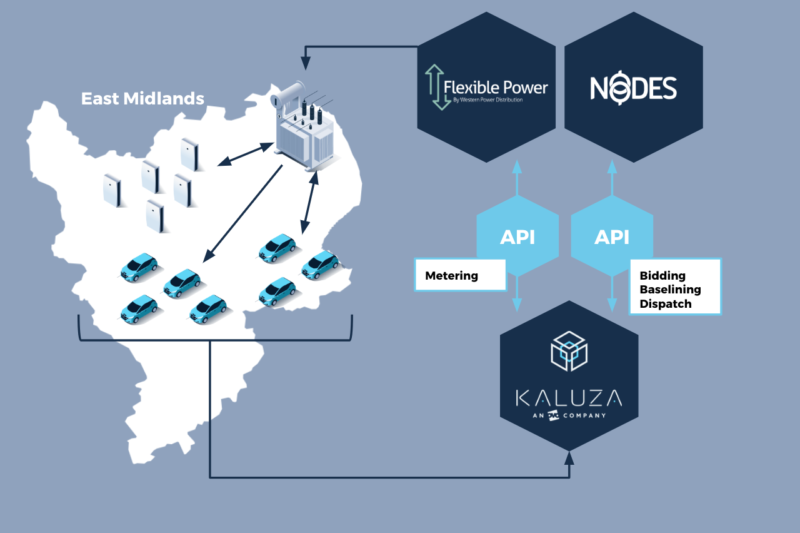
Western Power Distribution (WPD) – the grid distribution operator for the Midlands, Southwest and Wales – has launched an electric vehicle and household device management service in the East Midlands according to the project’s technology supplier on 24 August.
WPD has said it will work with community energy organisations in part to explain such projects to energy consumers.
It has previously explained in an animation it has plans to upgrade grid services because charging of consumer electric vehicles must be managed digitally to prevent excessive grid costs from being passed to consumers.
In a statement, London-based tech provider Kaluza, part of Ovo group, said it supplied the project with an intelligent energy platform that can control energy consumption in smart home devices and vehicles, the first of its kind in the UK.
WPD pays for the use of Kaluza’s platform that controls charging and discharging services using batteries based in homes.
The service leverages Kaluza’s AI technology to provide a fully automated, machine-to-machine operation with no need for manual intervention, said Kaluza.
Kaluza’s platform was supplied for part of a two-year innovation project paid for by Ofgem’s Network Innovation Allowance (NIA) fund, IntraFlex.
WPD launched the project in 2019.
Kaluza and WPD, together with energy marketplace platform IT provider NODES, plan to carry on working together on a new market design that “seeks to provide flexibility to all levels of the grid and unlock its value via an independent marketplace.”
First use of domestic devices to assist grid
The service also marks a milestone for domestic vechile-to-grid charging systems as Kaluza harnesses collective battery power to provide local flexibility to networks for the first time, Kaluza explained.
The platform targets shifting the time consumers charge their electric cars away from times of high demand, and “the devices import energy when it is cheapest and greenest for end customers and the grid”.
In addition, the charging stations use a kind of in-home battery called sonnenbatteries with available export capacity to help power the grid during high peaks in demand.
“Optimising a combination of domestic devices for flexibility has never previously been achieved and demonstrates the way forward to a scalable flex market at all levels of the energy system,” said Kaluza.
Kaluza's head of flexibility Conor Maher-McWilliams said, “Every day we take a step closer to realising a smarter energy system, but the launch of this service is a huge leap forward.
“While flexible, low carbon technologies become increasingly prevalent in people’s homes, there hasn’t been an effective way of coordinating charging across different types of devices to support grid balancing. This service changes that and will enable truly scalable flexibility so that millions of devices can store green and affordable energy in the future.
Roger Hey, DSO Systems and Projects Manager at WPD, said, “Our IntraFlex project and the work Kaluza and NODES are doing are bringing tomorrow’s world to us today. For us as a network operator, this project enables us to understand how all of these technologies will work together. For customers it brings forward the prospect of cleaner and cheaper energy in a way that can be replicated across the country.”